


The Bank of Canada has officially increased its key interest rate by 0.25 percentage points, bringing it to 2.50%. This marks the central bank's first rate hike since 2023. The

Garland Mortgage Solutions helps first-time home buyers in Mississauga and across Ontario understand pre-approvals, down payments, mortgage options, available programs, and the home-buying process.
Garland Mortgage Solutions helps self-employed borrowers and business owners in Mississauga and across Ontario understand income qualification, documentation requirements, and available mortgage options.
Garland Mortgage Solutions helps homeowners in Mississauga and across Ontario explore debt consolidation options using home equity, including mortgage refinancing and HELOC solutions.
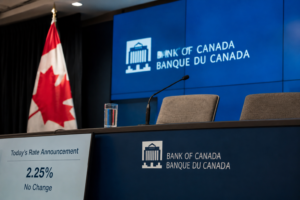
The Bank of Canada has once again decided to keep its policy interest rate unchanged at 2.25%, marking its seventh consecutive rate hold. The decision was widely expected, as the

Canada’s annual inflation rate increased to 3.0% in July, up from 2.8% in June, as higher gasoline and travel costs put renewed pressure on consumer prices. The increase came in

Inflation eases to 2.8% as gas prices cool ⛽📉 Canada's annual inflation rate slowed to 2.8% in June, down from 3.2% in May, according to Statistics Canada. The biggest reason?

The Bank of Canada announced today that it is keeping its key interest rate unchanged at 2.25%. This marks the sixth consecutive rate hold, a move that was widely expected

On June 10, 2026, the Bank of Canada announced that it is keeping its key interest rate unchanged at 2.25%. The decision reflects a mix of economic uncertainty, rising global
MariellaCantos marketing manager Linkedin Envelope Meet Mariella Mariella brings a background in hospitality, digital marketing, and content creation, with experience spanning social media management, branding, event coordination, and client-focused marketing. She

Canada Housing Affordability Improves as Mortgage Rates Drop
Canadian homebuyers finally caught a small break in July, as housing affordability improved in 12 of 13 major markets, according to Ratehub.ca’s latest report. Falling home prices combined with lower mortgage rates gave buyers a short-lived window of relief after years of surging costs. 💰 Rates and Income Requirements The average five-year fixed mortgage rate dipped to 3.94%, while the mortgage stress-test rate eased to 5.94%. That meant households needed less income to qualify for a mortgage: 📉 From Boom

📊 Inflation Climbs to 1.9% as Bank of Canada Decides on Rates
Canada’s annual inflation rate nudged up to 1.9% in August, slightly higher than 1.7% in July. The Consumer Price Index (CPI) dipped 0.1% month over month, but after seasonal adjustments it inched up 0.2%. Core inflation, which excludes gasoline, is at 2.4%, showing that underlying price pressures haven’t changed much. 🔑 Drivers Behind the Numbers Gasoline remained the big story. Prices at the pump kept falling ⛽, but the decline wasn’t as steep as July’s, partly because fuel costs were

Canada Loses 66,000 Jobs in August as Unemployment Climbs to 7.1%
📉 Job Losses at Pandemic-Era Levels Canada’s job market took a hard hit in August, shedding 66,000 jobs. Statistics Canada reported that the unemployment rate rose to 7.1%, its highest level since 2016 (if we set aside the peak COVID years). At the start of 2025, unemployment was 6.6%. Since then, it’s been climbing steadily, showing persistent weakness in the labour market. 🤔 Worse Than Economists Predicted Economists were expecting a small gain of 10,000 jobs and only a modest

🔮 Will the Bank of Canada Cut Rates? Key Takeaways from the Latest GDP Report
📉 GDP Takes a Hit The main culprit? Tariffs and weaker U.S. demand. Exports plunged 7.5%, with vehicle shipments tumbling almost 25%. Manufacturing also took a big hit, with many companies reporting tariff-related struggles. 🏡 Not All Doom and Gloom While exports dragged things down, there were some bright spots: In other words, Canadian households are still spending, and housing demand is holding up despite the economic headwinds. 🔮 What This Means for Rates Economists are split on what the

🏡 What Buyers Should Know About Canada’s Housing Market In 2025
🌱 A Slow Thaw After the Freeze Canada’s housing market is finally showing some movement after a long chill.📊 According to the Canadian Real Estate Association (CREA), national home sales have risen for four straight months. But here’s the catch: the recovery is patchy. Some regions are warming up, while others, like Toronto, are still lagging far behind their pandemic highs. 👉 John Lusink, president of Right at Home Realty, says Toronto remains a buyer’s market. Listings are steady, sales

📉 Canada Inflation Falls to 1.7% in July 2025
⛽ Relief at the Gas Pumps Canada’s annual inflation rate dropped to 1.7% in July, down from 1.9% in June, according to Statistics Canada. The biggest driver? Gas prices, which fell 16.1% year-over-year. This decline was largely due to the removal of the federal carbon price earlier this year. On a monthly basis, gas also slipped 0.7%, with global oil prices falling thanks to higher production from exporting countries and a ceasefire between Israel and Iran. Statistics Canada. (2025, August

📊 BoC Likely To Stay The Course As Job Market Holds Steady At 6.9%
Canada’s job market shrank by 40,800 positions in July, but Scotiabank economists say this drop isn’t enough to convince the Bank of Canada (BoC) to cut interest rates next month. Derek Holt, Scotiabank’s VP and Head of Capital Markets Economics, described the numbers as a “summer jobs report that masked underlying resilience.” He pointed out that July’s decline came after a strong 83,000-job surge in June, leaving the country with a net gain of 103,000 jobs so far in 2025.

🏡📉 Will Canadian Homeowners See Relief on Mortgage Rates?
The Canadian mortgage landscape is shifting again as bond yields fall and global uncertainty rises. While the Bank of Canada continues to hold its key rate, signs from the U.S. economy and trade tensions are adding pressure on the path forward. Could this signal a change for fixed mortgage rates? Let’s break down the latest updates and what they mean for borrowers. 🌍📉 Global Worries Are Shaping Canadian Rates Late last week, financial markets became uneasy as new signs pointed

🚨 RBC Just Made a Bold Mortgage Prediction
Canada’s major banks are no longer aligned on where interest rates are headed, but that’s not necessarily bad news for homebuyers. While most banks still anticipate more rate cuts from the Bank of Canada (BoC), RBC now believes the overnight rate may have already reached its floor, forecasting it will hold steady at 2.75% through 2026. This makes RBC’s outlook the most cautious of the Big Six, while others still foresee more downward movement. In its latest update, RBC pointed

🏡How Canadians Are Making Homeownership Work In 2025
Despite high home prices and rising borrowing costs, many Canadians are still finding ways to enter the housing market, thanks to family support, rental income, and expert guidance from mortgage brokers. A new 2025 survey by Mortgage Professionals Canada highlights how buyers are adapting and leaning on resources to make homeownership possible. 👪 Family support is helping close the gap According to the survey, 7 in 10 recent buyers say they wouldn’t have been able to purchase their home without

Canada’s Inflation Up To 1.9%, But Still Under BoC Target
Canada’s inflation rate increased in June, but not enough to raise major concerns from the Bank of Canada. While prices are trending upward in certain areas, overall inflation remains under control and below the central bank’s target. This latest update comes just ahead of the Bank’s next interest rate decision, and it offers limited pressure for any immediate changes. 📈 What the Numbers SayAccording to Statistics Canada, the Consumer Price Index (CPI) rose 1.9% in June compared to the same

📊Population Shifts, But Housing Demand Stays Strong
Over the past decade, strong population growth — especially from immigration — helped fuel hot housing markets in Ontario and BC. Cities like Toronto and Vancouver saw non-stop demand for homes 🏙️🏡. But with the federal government announcing lower immigration targets in the years ahead, some are wondering: Will this slow down the housing market? 📉 Yes, Population Growth Is Easing — But There’s More to the Story Early in 2025, both BC and Ontario experienced slight population declines —
