
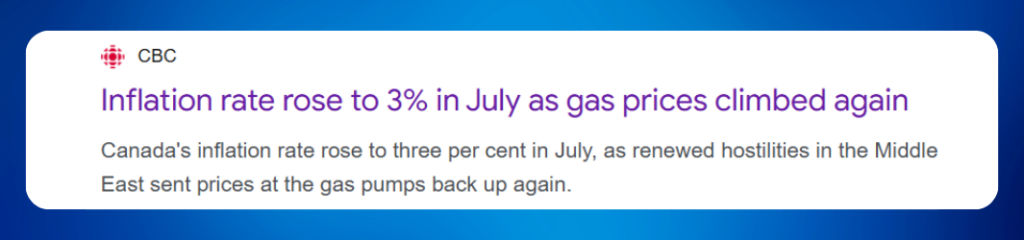
Canada’s annual inflation rate increased to 3.0% in July, up from 2.8% in June, as higher gasoline and travel costs put renewed pressure on consumer prices.
The increase came in slightly above economists’ expectations of approximately 2.9%.
⛽ Gas Prices Push Inflation Higher
One of the biggest contributors to July’s increase was gasoline.
Gas prices were 25.7% higher compared to July last year, accelerating from a 20.5% year-over-year increase in June.
Statistics Canada pointed to renewed conflict in the Middle East, including disruptions in the Strait of Hormuz and shipping routes through the Red Sea, as factors putting upward pressure on global energy prices.
This was a reversal from June, when peace talks temporarily eased geopolitical tensions and helped bring energy prices down.
✈️ Travel Costs Also Increased
Canadians also faced higher travel expenses in July.
Prices for travel tours increased as hotel and airfare costs to U.S. destinations climbed amid demand surrounding the FIFA World Cup.
Higher jet fuel costs added further pressure, with air transportation prices rising 12% year-over-year, compared with a 9.6% increase in June.
However, some economists believe these pressures could be temporary as World Cup-related demand has passed and gasoline prices have started to ease slightly in August.
🛒 Grocery Inflation Cools
There was some relief at the grocery store.
Prices for food purchased from stores increased 3.1% year-over-year in July, slowing from 3.9% in June.
The slowdown was largely driven by more moderate price growth for:
🥦 Fresh vegetables
🍗 Chicken
🥣 Cereal products
Fresh fruit was an exception. Prices rose 6.1% year-over-year, with berries and melons seeing particularly strong increases.
Despite July’s improvement, Statistics Canada noted that grocery inflation has now exceeded overall inflation for 18 consecutive months.
📊 What Happened to Core Inflation?
Measures of underlying inflation remained relatively stable, although some came in slightly higher than economists expected.
When gasoline is removed from the calculation, the Consumer Price Index increased 2.2% year-over-year in July, marking the third consecutive month at that level.
The Bank of Canada’s preferred CPI-trim and CPI-median measures were also slightly stronger than expected. However, BMO Senior Economist Robert Kavcic noted that these measures remain within the Bank of Canada’s inflation target range.
Overall, the underlying inflation picture continues to appear relatively stable despite July’s increase in the headline number.
🏦 What Could This Mean for Interest Rates?
July’s inflation report is especially important because it is the final inflation reading before the Bank of Canada’s September 2 interest rate announcement.
The Bank has kept its benchmark interest rate at 2.25% for six consecutive decisions.
While headline inflation moved higher in July, economists at BMO and CIBC do not believe the latest numbers create an immediate need for another rate increase.
Both expect the Bank of Canada to hold its policy rate steady in September and currently anticipate rates remaining unchanged for the rest of 2026.
🔍 The Bottom Line
July brought some renewed inflation pressure, particularly from gasoline and travel. At the same time, grocery inflation slowed and underlying inflation measures remained relatively contained.
For the Bank of Canada, the report suggests inflation is worth watching, but there may not be enough evidence yet to justify changing interest rates.
With the next rate decision coming on September 2, attention will now turn to the latest employment, economic growth and other incoming data for clues about what the Bank may do next.
