
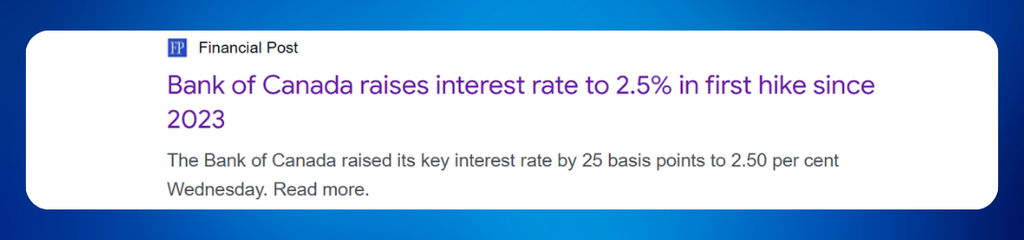
The Bank of Canada has officially increased its key interest rate by 0.25 percentage points, bringing it to 2.50%. This marks the central bank’s first rate hike since 2023.
The decision comes as inflation continues to remain higher than expected, raising concerns about how long Canadians will face increased living costs.
Here’s a breakdown of what happened, why the Bank of Canada made this decision, and what it could mean for your mortgage.
📈 Why Did the Bank of Canada Raise Interest Rates?
The main reason behind the increase is persistent inflation.
Canada’s inflation rate reached 3.1% in September, following readings of 3.0% in both July and August.
While underlying inflation measures have remained closer to 2%, certain expenses have continued to rise significantly, including:
- ⛽ Gasoline and energy costs
- ✈️ Travel and transportation expenses
- 📦 Imported goods and services
Energy prices alone increased by approximately 19% compared to September 2025.
The Bank of Canada is also concerned that businesses may begin passing their higher operating costs on to consumers, potentially pushing prices even higher.
In fact, a recent Bank of Canada survey found that approximately half of businesses surveyed plan to pass increased fuel costs on to customers before the end of the year.
🔥 Inflation Could Stay Higher for Longer
The Bank of Canada’s latest Monetary Policy Report suggests inflation may take longer to settle down than previously expected.
The central bank has updated its inflation forecasts:
- 📊 2026: Average inflation is expected to reach 2.9%, up from the previous forecast of 2.5%.
- 📊 2027: Inflation is projected to average 3.1%, compared to the earlier forecast of 2.0%.
Inflation is now expected to remain above 3% for the rest of 2026 and much of 2027.
Higher energy prices and increased import costs are expected to continue putting pressure on household budgets, with inflationary pressures gradually easing into 2028.
What does this mean for Canadians?
Everyday expenses could remain elevated for longer, making it more challenging for households to manage their budgets.
🔮 Will the Bank of Canada Raise Rates Again?
Another rate increase is possible, but nothing has been confirmed.
Bank of Canada Governor Tiff Macklem explained that policymakers considered two options at this meeting: keeping rates unchanged or increasing them.
Ultimately, concerns about persistent inflation and the economy’s ability to withstand higher borrowing costs led to the decision to raise rates.
Looking ahead, the Bank of Canada plans to evaluate economic conditions at each upcoming meeting before making further decisions.
With the policy rate now at 2.50%, it is approaching the approximately 2.75% level that some economists and central bank officials consider neutral, meaning a rate that neither stimulates nor slows economic activity.
However, this does not necessarily mean rates will stop increasing.
The central bank will continue monitoring inflation, economic growth, employment, and global developments before deciding its next move.
🏡 What Does This Mean for Your Mortgage?
If you’re a Canadian homeowner or planning to purchase a property, here’s how this rate increase could affect you.
🔹 Variable-Rate Mortgage Holders
Variable-rate mortgages are generally tied to lenders’ prime rates, which tend to move alongside the Bank of Canada’s policy rate.
With this latest increase, borrowers with adjustable-rate mortgages could see their payments rise.
For some variable-rate mortgages with fixed payments, the monthly payment may remain unchanged, but a larger portion could go toward interest instead of principal.
🔹 Fixed-Rate Mortgage Holders
If you already have a fixed-rate mortgage, your interest rate and scheduled payments will generally remain unchanged until your term ends.
However, if you’re approaching renewal, it’s important to review your options early.
Fixed mortgage rates are influenced more directly by bond yields than by the Bank of Canada’s policy rate, so they don’t necessarily increase by the same amount.
🔹 Homebuyers
Higher borrowing costs can affect mortgage affordability and how much you may qualify to borrow.
If you’re planning to buy a home, understanding your mortgage options and preparing a strategy ahead of time can help you make more informed decisions.
💡 Should You Lock In Your Variable-Rate Mortgage?
Our Take: Not Necessarily.
Although the Bank of Canada has increased its policy rate, we don’t believe homeowners should rush into locking in their variable-rate mortgages based on one announcement.
Fixed mortgage rates have already increased, which means switching to a fixed rate today may not necessarily offer better value.
We also recognize that Canada’s recent employment figures have shown signs of weakness, and further interest rate increases could put additional pressure on the economy.
While inflation remains a concern, we believe it’s important to consider the bigger economic picture before making a long-term mortgage decision.
We’ll continue monitoring inflation, employment data, bond yields, and future Bank of Canada announcements. If we believe additional rate increases are becoming more likely, we’ll update our recommendations accordingly.
Remember, every mortgage situation is different. The right decision depends on your current rate, remaining term, financial goals, and comfort with potential payment changes.
📌 The Bottom Line
The Bank of Canada’s decision to raise its policy rate to 2.50% reflects growing concerns that inflation could remain elevated longer than previously anticipated.
Whether you’re buying a home, approaching renewal, or currently holding a variable-rate mortgage, having a mortgage strategy can help you navigate changing market conditions with greater confidence.
📲 Have questions about how this rate increase affects your mortgage? Reach out to our team. We’re here to help you understand your options and plan your next steps.
Source: Bank of Canada, October 2026 Monetary Policy Report and October 28, 2026 interest rate announcement.
Disclaimer: This article is for general information only and does not constitute personalized financial advice. Mortgage rates, payment changes, and available options depend on your lender and mortgage terms.
