
Canada’s housing market is going through some changes this year, but they aren’t necessarily bad —especially for buyers and sellers who know how to work with the market, not against it.
The Canadian Real Estate Association (CREA) has revised its 2025 forecast last Friday, lowering its expectations for both home sales and average prices. About 482,673 homes are now expected to sell this year, which is roughly 50,000 fewer than what CREA predicted at the start of the year. The national average home price is also expected to be a little lower, landing around $687,898.

According to CREA’s Senior Economist Shaun Cathcart, predicting the market right now isn’t easy—similar to how unpredictable things felt at the beginning of the pandemic. But even with all the uncertainty, a calmer, more balanced market is often when real opportunities open up for buyers and sellers who are ready.
In March, national home sales dropped by 4.8% compared to February. At the same time, new listings rose by 3%, helping ease some of the supply pressure that defined the market in past years.
The MLS® Home Price Index, which tracks home price trends more precisely than simple averages, slipped by 1% month-over-month and is now down 2.1% compared to March of last year.
Sales activity has cooled to a level we haven’t seen since 2008. But it’s important to remember: this isn’t 2008. This slowdown looks more like a natural adjustment after years of rapid growth, not a crash.
More homes on the market and slightly lower prices are creating space for buyers who spent the last few years competing in crowded, high-pressure conditions.
One of the biggest changes this spring is the shift in buyer power.
Canada’s sales-to-new listings ratio fell to 45.9% in March. For context, the long-term average is closer to 55%. When the ratio falls below 45%, we typically start talking about a buyer’s market.
In plain terms: buyers today have more choices and a lot less pressure to rush their decisions compared to the peak years. Offers with conditions, proper home inspections, and price negotiations are making a comeback.

If you’ve been sitting on the sidelines, 2025 could offer the right kind of environment to make a move—especially if you’re working with someone who knows how to navigate these shifts.
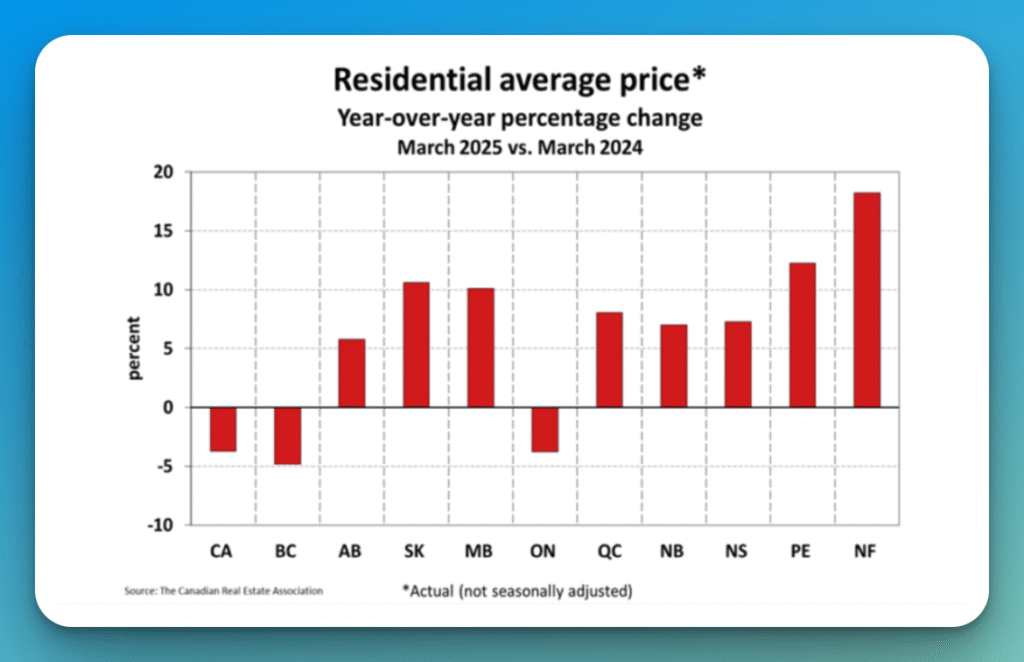
The national average price for a home in March was $678,331, which is about 3.7% lower than a year ago.
Ontario and British Columbia, two of the hottest markets over the last decade, are leading the price declines. Meanwhile, places like the Prairies, Quebec, and Atlantic Canada are holding steady—or even seeing modest price gains.
This reminds us that real estate is local. What’s happening nationally matters, but what’s happening in your specific market will make the real difference when you’re buying or selling.
At the start of the year, CREA expected a stronger spring market fuelled by lower interest rates and pent-up demand. But with economic uncertainty growing and tariffs now in place, they’ve adjusted the outlook.
Here’s what they’re seeing now:
- Ontario and British Columbia are expected to see further declines in both sales and prices.
- Home sales are expected to stay roughly even with 2024 levels.
- Newfoundland and Labrador, Quebec, and Prince Edward Island are projected to see slight sales growth.

On a national level, prices are now expected to dip slightly by about 0.3%. But again, it will depend heavily on where you are: some provinces, like Alberta, New Brunswick, and Newfoundland and Labrador, could still see price gains by the end of the year.
Valérie Paquin, CREA’s new Board Chair, summed it up well:
“There are parts of Canada with record-low inventory and rising prices, and others with the highest inventory levels in a decade. If you’re planning to buy or sell in 2025, it’s crucial to understand your specific market.”
Markets change. They always have — and they always will. What matters is understanding how they’re changing and having a strategy that moves with them.
At Garland Mortgage Solutions, we work with buyers, sellers, and homeowners every day to help them read the market clearly—and make smarter mortgage decisions because of it.
If you want advice that’s based on where the market is actually heading, not where it’s been, let’s talk. The right strategy now can make all the difference later.
