
Will The Bank Of Canada Pump The Brakes?
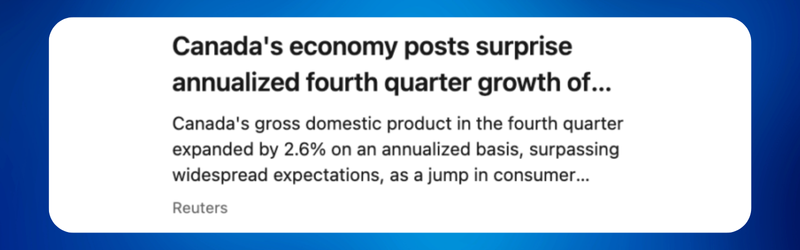
Economists were expecting a sluggish end to the year, but December’s unexpected rebound has added a fresh layer of uncertainty to the Bank of Canada’s next move. According to the latest GDP report, the economy expanded by 0.2% in December, following a contraction in November. On an annualized basis, Canada’s economy grew by 2.6% in the fourth quarter of 2024—well above expectations. The driving forces? A spike in consumer spending, fuelled by the sales tax holiday, and a rush of businesses exporting goods ahead of potential new U.S. tariffs.

But with these tariffs set to take effect as early as next week, the question remains: Will the Bank of Canada pause its rate cuts, or continue easing monetary policy to cushion against potential economic shocks?

What’s Driving Economic Growth?
The surprising strength of the Canadian economy at the end of 2024 comes down to a few key factors:
- Labour Market Strength: Despite concerns over slowing job growth, recent employment data suggests a resilient workforce.
- Consumer Spending: Canadians took full advantage of the sales tax holiday, pushing household consumption up 1.4% in Q4.
- Exports Surge: Businesses ramped up exports by 7.4% as they tried to get ahead of looming U.S. tariffs.
January’s early estimate shows another 0.3% increase in GDP, signalling continued momentum. Without the looming tariff risk, many economists believe the Bank of Canada would have had a clear case for pausing rate cuts.
The Bank of Canada has been steadily cutting interest rates since June 2024, bringing the overnight rate from 5% to 3%. Lower rates have helped ease financial pressure on households and businesses, but with the latest economic data looking stronger than expected, the case for additional cuts is no longer as clear-cut.
Economists are now divided on what the Bank of Canada will do next. Some argue that a pause is necessary to assess how the economy is responding, while others say the threat of tariffs means another rate cut might be needed to offset potential downturns in investment and trade.
What Are Experts Saying?
Leading economists have weighed in on what the latest GDP report means for rate cuts:
- Avery Shenfeld (CIBC Economics): “Without the threat of tariffs, the Bank of Canada would have reason to pause rate cuts for several months. But with tariff uncertainty hanging over the economy, another cut could still be on the table.”
- Nathan Janzen (RBC Economics): “Household spending is showing signs of life, and inflation is still manageable. Unless tariffs are imposed next week, the Bank of Canada may hold off on another cut in March.”
- James Orlando (TD Economics): “Governor Macklem is more concerned about risks ahead rather than past data. Given the uncertainty, the Bank’s next move is a coin toss.”
- Tu Nguyen (RSM Canada): “Without tariffs, Canada’s economy is well-positioned for 2025. But if tariffs happen, another rate cut may be necessary.
For mortgage holders and prospective buyers, this uncertainty makes it even more important to stay informed. If the Bank of Canada pauses its rate cuts, mortgage rates may stabilize at current levels. However, if tariffs hit and the economy slows, another rate cut could push borrowing costs lower.
Canada’s economy has demonstrated unexpected resilience, but uncertainty looms as new U.S. trade policies could shift the outlook in the coming weeks. The Bank of Canada’s next interest rate decision on March 12 will be a critical moment for homeowners and buyers, as it will determine whether rates hold steady or continue their downward trend. Much of this decision hinges on whether the U.S. implements its planned tariffs, which could create additional economic headwinds.
At Garland Mortgage Solutions, we understand how shifting economic conditions impact your ability to secure the best mortgage rates. Whether you’re looking to buy a home, refinance, or explore your options in this changing market, our team is here to provide expert guidance and help you navigate these uncertain times with confidence.
