The Hidden Hand Behind Fixed Rates: The Role Of The Term Premium🌎🏡
When it comes to borrowing, Canadian mortgage holders are often told that fixed and variable rates respond to different forces. The Bank of Canada (BoC) tends to steer variable rates, whereas fixed rates are tethered to the ups and downs of the bond market.
While this is mostly accurate, it’s an oversimplification. In reality, variable and fixed rates are more like siblings than distant cousins. Both are influenced by market expectations, central bank policy, and global financial trends. Fixed rates, for instance, closely follow movements in the bond market, with particular attention paid to the yield on 5-year Government of Canada bonds. This bond yield gives an idea of where fixed rates might go, but there’s a more complex story lurking behind the numbers.
The Ingredients Behind Fixed Rates: Rate Expectations And The Term Premium
For many Canadian borrowers, it’s a surprise to learn that, like variable rates, bond yields and therefore fixed mortgage rates are largely influenced by BoC policy and the anticipated direction of interest rates. Fixed rates aren’t just a function of bond yields, though; they’re driven by two major factors:
Rate Expectations: This is the anticipated path of the BoC’s overnight rate over the next five years.
The Term Premium: This is the extra yield investors demand to commit to a longer-term bond, like a 5-year bond, rather than rolling over shorter-term, less risky government securities.
The term premium is a critical, though often overlooked, factor in determining fixed mortgage rates. It’s influenced by numerous factors, including investor sentiment, inflation fears, and economic outlooks. As the term premium rises, so do bond yields, which can, in turn, raise fixed mortgage rates.
The Role Of Rate Expectations In Setting Fixed Rates
The expected path of the BoC’s policy rate (or the “overnight rate”) plays a central role in shaping the yield curve, which in turn impacts fixed mortgage rates. Right now, most forecasters are predicting a downward trajectory for rates, with economic conditions and inflation indicators suggesting that the BoC might pivot towards rate cuts in the near future. Market-based metrics, like the Overnight Index Swap (OIS), reflect these expectations and provide a reasonably transparent outlook.
In Canada, as in the U.S., financial markets widely expect that the BoC will begin to ease interest rates due to slowing economic growth and receding inflationary pressures. The current consensus suggests a 100-basis-point reduction over the coming year. Yet, even with expected BoC cuts, fixed rates haven’t budged as much as variable rates are projected to. That’s partly due to the increasing term premium.
The Term Premium: The “Extra Cost” in Fixed Rates
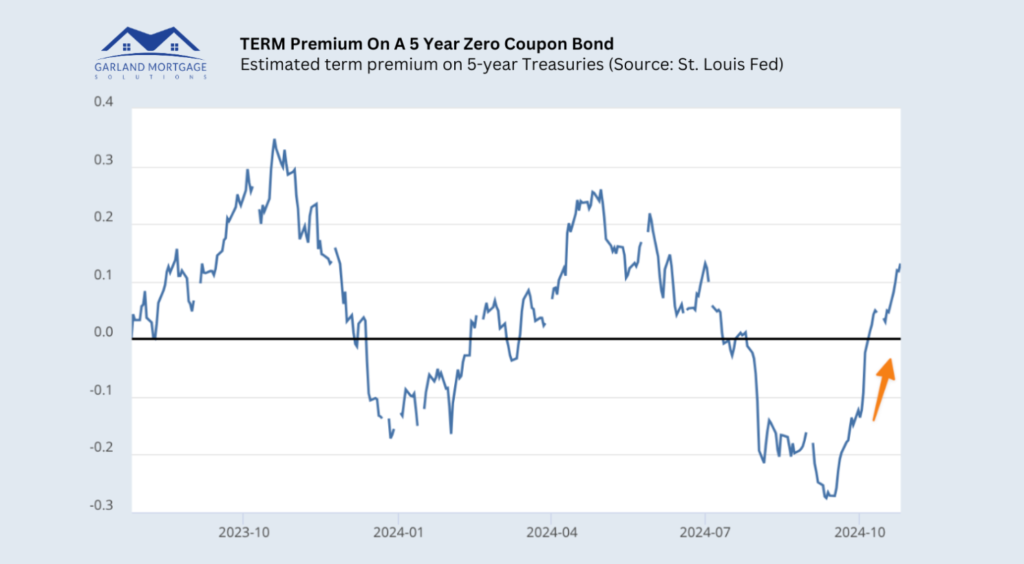
The term premium reflects the risk investors take on when they choose to lock up their funds in longer-term securities. To compensate for the added uncertainty, investors demand a higher yield. Recent events show just how influential this premium can be. In the U.S., for example, the term premium on 5-year bonds has surged by 40 basis points in the last month, pushing up bond yields worldwide, and Canada has felt this pull.
Term premia are generally higher in the U.S. than Canada, but unfortunately, we know of no source that estimates Canadian term premiums on an ongoing basis.
This means that Canadian fixed rates could face upward pressure even if the BoC signals lower rates. Canadian markets don’t calculate the term premium as directly as the U.S. does, but trends in the term premium can significantly influence our rates. The current increase is driven by a mix of factors, including higher government debt issuance, inflation fears, and an environment of rising deficits. The term premium’s ascent adds complexity to the rate forecast, meaning that fixed rates may remain elevated even as the BoC considers lowering the overnight rate.
For borrowers, understanding the term premium’s influence is vital. Canada’s fixed rates are subject to global forces beyond the BoC’s immediate control. Recently, fiscal policies, deficit spending, and fears of re-inflation have all contributed to a higher term premium. This mix of factors could sustain or even further increase fixed rates, creating a scenario where variable and fixed rates diverge more sharply.
In the current landscape, many fixed-rate mortgage borrowers are betting that variable rates won’t undercut fixed rates significantly or quickly enough to make a floating rate worthwhile. Given recent market dynamics, this isn’t an unreasonable stance. While variable rates are likely to drop, fixed rates have already descended from their previous highs, and they may remain steady or dip only modestly in the near term. If the term premium keeps climbing, fixed rates may barely budge even if the BoC cuts its overnight rate.
What Lies Ahead for Fixed Rates?
Global forces are exerting powerful influences on Canada’s fixed mortgage rates. Even if the BoC aggressively cuts rates, the term premium could prevent fixed rates from seeing equivalent declines. And with the upcoming U.S. election, there’s additional uncertainty. Fiscal policies, trade tariffs, and potential inflationary pressures under a new U.S. administration could create spillover effects, adding further fuel to the term premium.
This shifting environment means that borrowers may need to adjust their strategies accordingly. For some, variable rates could offer savings potential, especially if rate cuts accelerate. However, given the higher term premium’s effect on fixed rates, borrowers might consider locking in current fixed rates rather than banking on significant future rate reductions.
BoC’s Rate Flexibility: “We’re prepared to make a 50-basis-point cut if conditions call for it. And if another is needed, we won’t hesitate.” —BoC Governor Tiff Macklem.
With the BoC hinting at flexibility, Canadian borrowers could see a 50-basis-point cut as early as this month. This rate outlook favours variable rates, but the term premium is likely to hold fixed rates relatively steady.
Canada’s major banks just wrapped up their fiscal year on October 31, rolling out new mortgage plans on November 1. If banks’ mortgage volumes rise as expected, they may dial back competitive pricing efforts. Higher volumes give banks the option to prioritize profitability over rate competition, especially if more borrowers flock to variable rates.
A Weakening Loonie and Mortgage ImplicationsThe Canadian dollar faces a tough outlook, with factors like the U.S. rate advantage, softening commodity prices, and growth differentials against the U.S. all working against it. This has significant implications for mortgage borrowers, particularly those in variable-rate mortgages. A depreciating loonie can increase import costs, adding inflationary pressures that the BoC cannot ignore. Some estimates suggest that each penny drop in the CAD/USD exchange rate could add more than 10 basis points to Canada’s inflation rate, which could, in turn, pressure the BoC to delay or reduce the scale of any planned rate cuts.
Canadian mortgage holders need to weigh their options carefully. Global forces are at play, making it crucial to stay informed about market movements. Borrowers choosing variable rates might benefit if the BoC cuts rates as expected, but those locking in fixed rates today could also avoid potential volatility if term premiums remain high.
In short, while variable rates could offer more immediate savings if the BoC follows through on rate cuts, fixed rates are already relatively low, and borrowers may want to consider securing a fixed rate before further term premium hikes. And remember, as the political landscape shifts south of the border, the ripple effects on Canada’s mortgage market may be substantial.
At Garland Mortgage Solutions, we’re watching these changes closely to keep you informed and prepared for what’s ahead 🔍. Have questions about your mortgage options? 💬 Don’t hesitate to reach out – we’re here to help make your home financing journey smoother! 🛤️✨